⚓ 🌊Gnots, Captain Mark, and KC, (The Kid), Spring Rolls
😂⛵ Knots: The 3 You’ll Actually Use 🌊🤣
😂⛵ Three knots, countless uses, and fewer opportunities to embarrass yourself at the dock! 🌊🤣
There are hundreds of knots in the sailing world. You could spend a lifetime learning them all, fill a library with knot books, and still find someone at the marina who insists you’ve tied yours incorrectly.
But here's the good news, fellow Gnomads: you can handle a surprising amount of everyday sailing with just three knots.
Meet your new best friends: the cleat hitch, the bowline, and the clove hitch. Learn these three, practice until your fingers remember them, and you'll be well on your way to looking like you know what you're doing. 😎
Let's untangle things!
1. ⚓ The Cleat Hitch
Use it for: Securing dock lines to a cleat.
You’ve arrived at the marina. There’s a perfectly good cleat on the dock, a perfectly good cleat on the boat, and a line in your hand. Now what?
How to tie it:
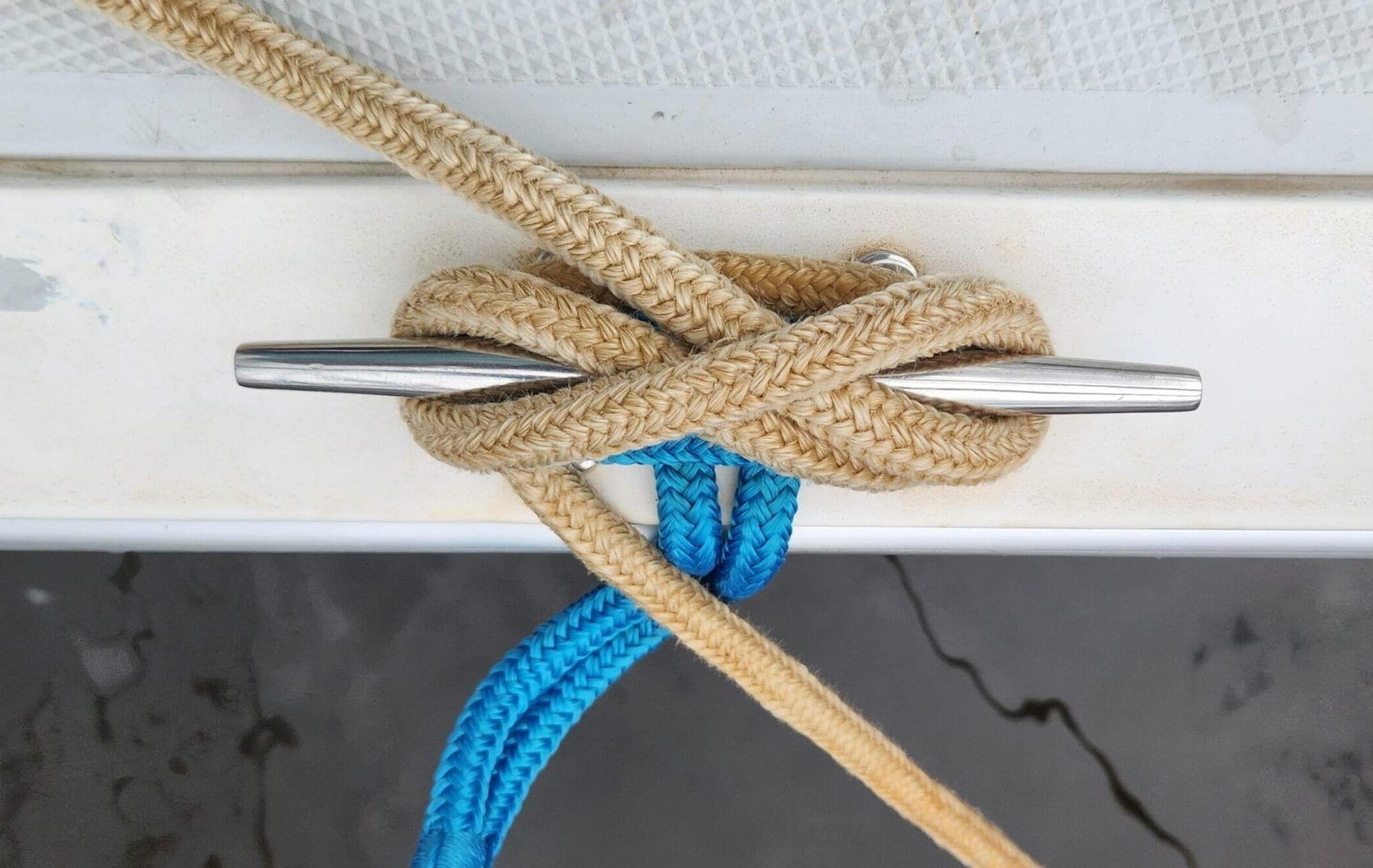
- Lead the line to the far horn of the cleat (the one away from the boat) and take a full turn around the base.
- Cross diagonally over the top and around the other horn. That’s your figure eight. One is plenty.
- Twist a small loop in the line and drop it over the horn so the tail lies alongside the last diagonal. Done! 🎉
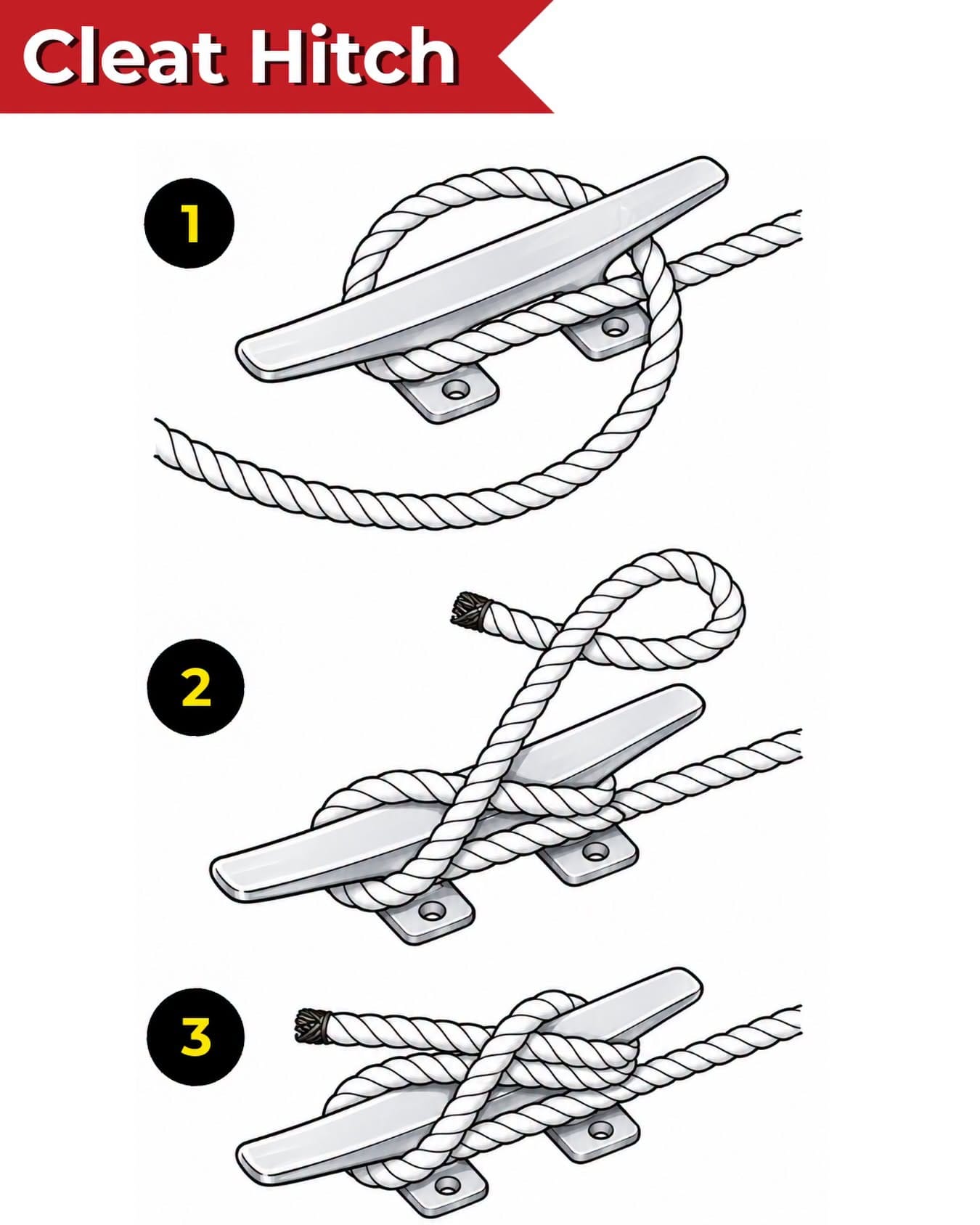
G~Man’s tip: One locking hitch. Not three. Not “keep wrapping until it looks safe.” A cleat hitch that looks like a plate of spaghetti 🍝 is harder to undo and no stronger. Neat holds. Mess doesn’t.🍝
Remember: The cleat must be strong enough for the load, and the line must be led so it won't chafe or jump off the cleat.
2. 🪢 The Bowline
Use it for: a fixed loop at the end of a line that won’t tighten down on you.
It’s one of the most useful knots in sailing. It’s also a great party trick, for people who think ropes are exciting. We know who we are! 😂
How to tie it:
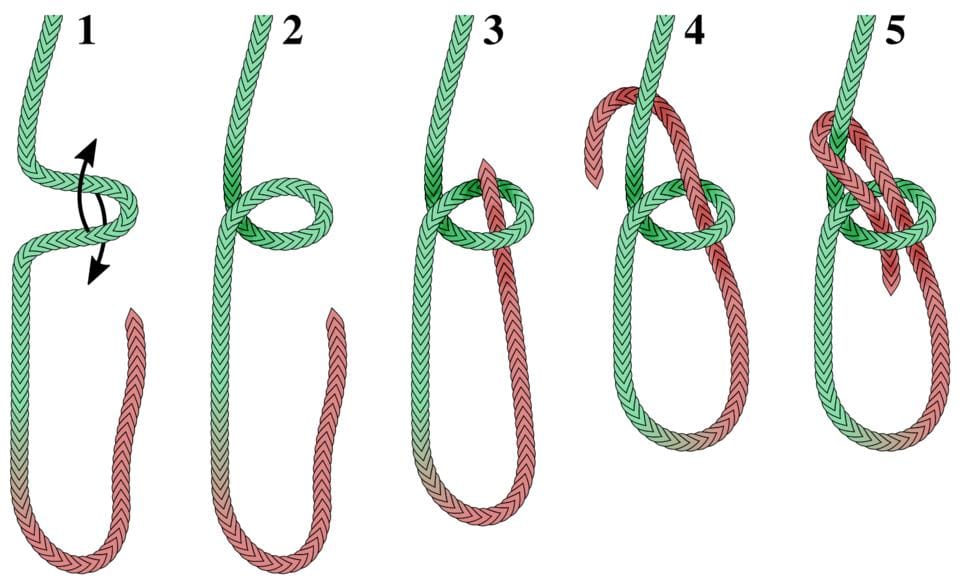
- Decide how big you want your loop. At that spot, make a small loop in the line with the working end lying on top. (Get this backwards and the whole thing falls apart when you pull it. Ask me how I know.)
- Bring the end up through the small loop from underneath.
- Take it around behind the standing part.
- Bring it back down through the small loop.
- Hold the end against the big loop and pull the standing part to set it.
You’ve probably heard the rhyme: the rabbit comes out of the hole, runs around the tree, and goes back down the hole. 🐇🌳 The rabbit is the end, the tree is the standing part, and the hole is your little loop.
G~Man’s tip: Practice until you can tie it without asking the internet. Fast is nice. Right is what matters.
Heads up: A bowline can shake loose when it isn’t under load. Leave a good long tail and give it a check now and then.
3. ⛵ The Clove Hitch
Use it for: Attaching a line to a rail, post, or other suitable object. Used EVERY day for fenders on the boat.
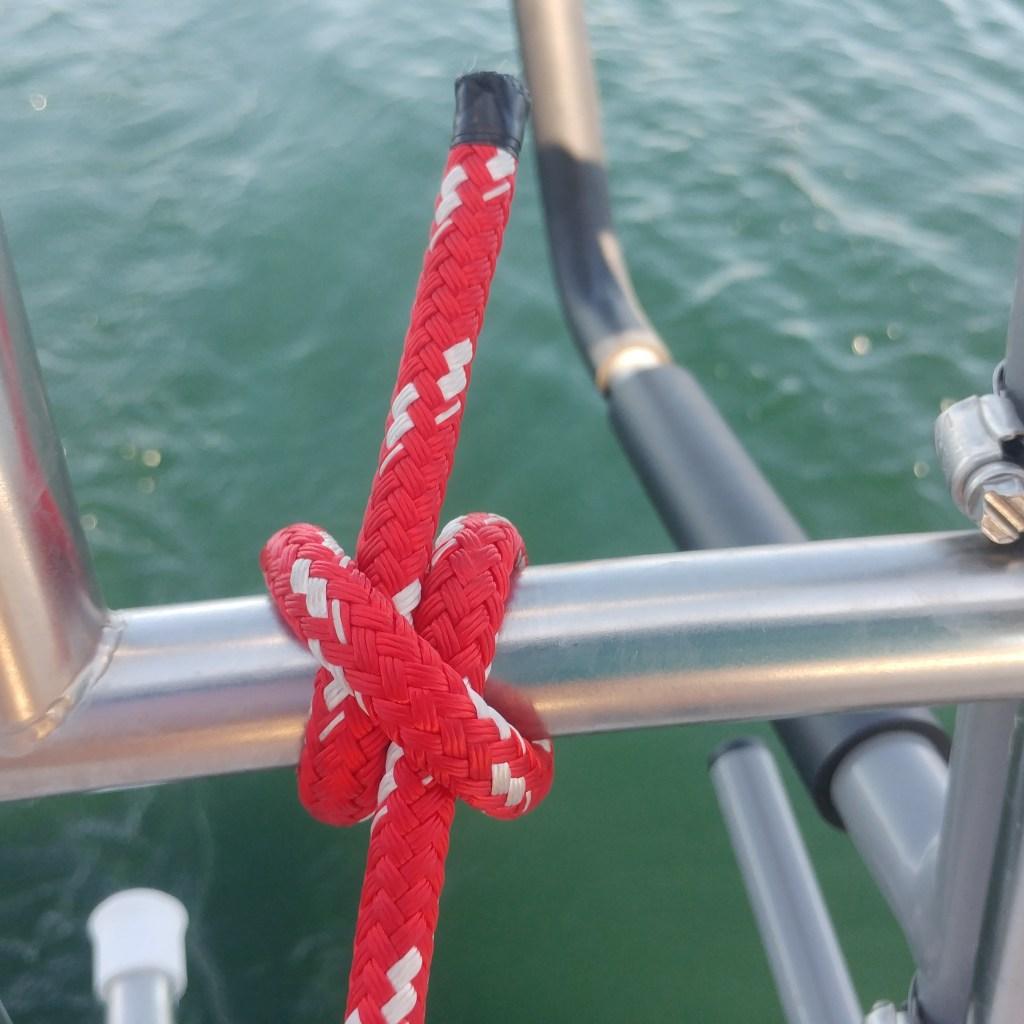
It’s quick, easy to adjust, and perfect for hanging a fender off the lifeline or a stanchion at just the right height.
How to tie it:
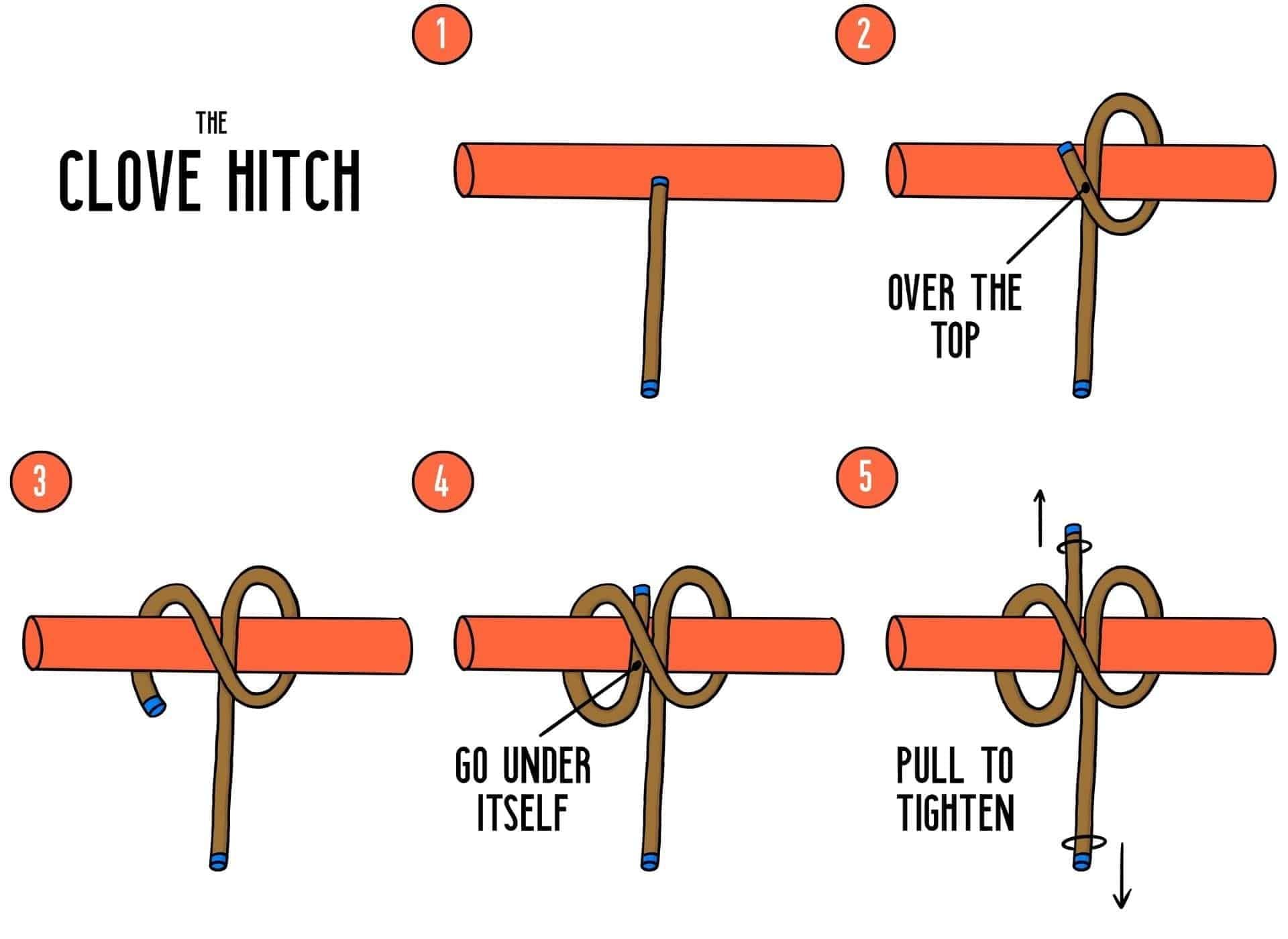
- Wrap the line once around the rail.
- Cross over that first wrap and go around a second time.
- Tuck the end under the second wrap and pull both ends snug.
G~Man’s tip: Clove hitches love to wiggle loose on a smooth rail, especially when the fender’s bouncing around. Add a half hitch around the standing part for insurance, and check your fenders before you come into the dock, not after. 👀
Heads up: Great for fenders. Not for dock lines or anything you’d be sad to lose.
🧭 The Gnomad Knot Challenge
Here's your mission before your next sailing adventure:
1 Tie a cleat hitch neatly and securely.
2 Tie a bowline without looking at the instructions.
3 Tie a clove hitch around a suitable rail or post.
4 Repeat each knot until you can tie it confidently without having to think through every step.
Then get a crewmate to test you. Bonus points if you can tie them while explaining why they're useful, although excessive knot-related bragging may result in your being assigned the next round of galley duty. 🍳😂
🏴☠️ Final Thoughts from the G~Man
Sailing isn't about knowing every knot ever invented. It's about knowing which knot to use, when to use it, and how to tie it correctly.
These three will serve you well in many everyday situations aboard and around the boat:
- The cleat hitch secures your boat to a cleat.
- The bowline creates a reliable fixed loop.
- The clove hitch attaches a line to a suitable rail or post.
Learn them, practice them, and understand their limitations. You'll be a more confident sailor and a more useful crewmate.
Because the best time to discover you can't tie a knot is not when the wind is blowing you away from the dock! 🌬️⛵
Fair winds, happy knots, and may your lines always be tidy!
The G~Man ✌️❤️
Gnomad Sailing: Less stress, more adventure, and always room for one more knot in the rope locker.
⛵ Guest Spot: Captain Mark
⚓ Bluewater Sailor, Tech Enthusiast & Builder, Skipper of Keeldragger⚓
⛵ Another friend from my orbit this week: meet Captain Mark Bunch of S/V Keeldragger! 👋
Some of you already follow his YouTube channel (it's in my recommended list below). Mark just got back from sailing a big loop around the Pacific, and now he's building something every Southern California sailor should have on their phone. Take it away, Mark! 🌊
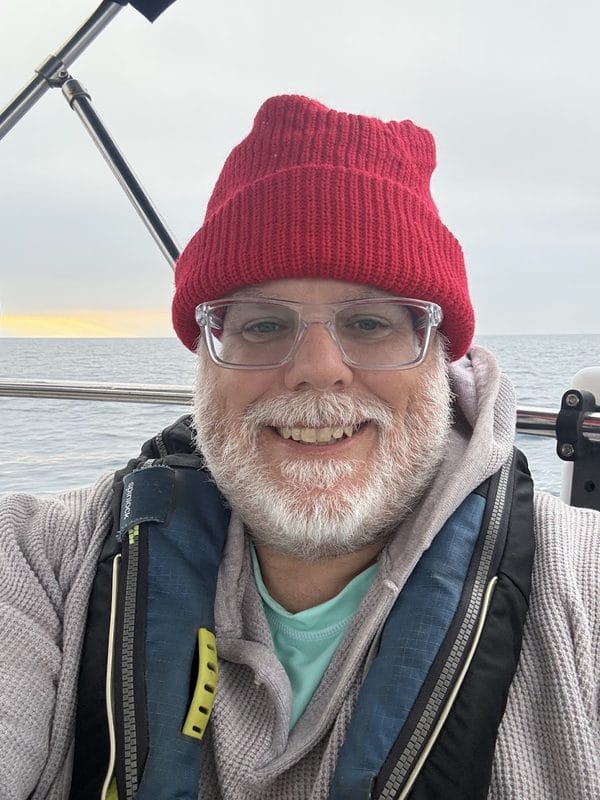
I learned to race on Midwest lakes and moved to Southern California for bigger horizons. Six boats later (a Catalina 22, a Tartan 27, a Star, a Fuji 35, a Dana 24 and now a 1988 Valiant 40 named Keeldragger) and roughly 25,000 miles under the keel, fifteen thousand of them offshore, I'm still dragging keels across the Pacific.
From December 2024 to July 2025, Keeldragger and I sailed 11,750 nautical miles on what I call Keeldragger's Great Pacific Adventure, from San Pedro down through Mexico, across to French Polynesia, north to Hawaiʻi and home to Catalina. That's a story for another day, and I'll tell it properly in a future guest spot.
Home Waters, and a Passion Project
When I got back from the Pacific, I finally finished my USCG 50-Ton Master license with a Sailing endorsement. With that box checked, I had time to pursue my next passion project.
Here's the funny thing about sailing across an ocean: you come home with a whole new appreciation for your own backyard. Southern California has some of the most interesting cruising anywhere. There's Catalina, the Channel Islands and the whole Southern California Bight, with marine layer mornings, afternoon westerlies, shipping lanes, military ranges, marine protected areas and anchorages that are perfect one night and rolly the next.
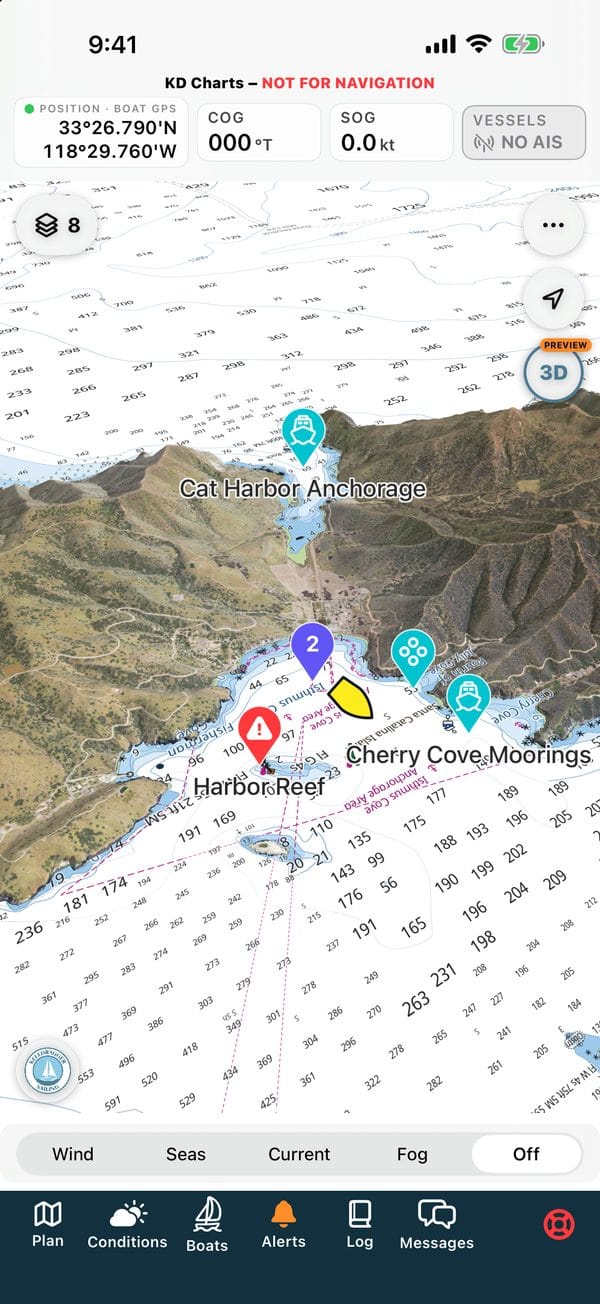
After dozens and dozens of my own adventures sailing the Bight, I felt I'd picked up enough local knowledge to build something that could help inform others in the sailing community. The result is Keeldragger Sailing SoCal: hyperlocal charts, mariner's information and first-hand guidance for Catalina, the Channel Islands and the SoCal Bight, all in one place.
KD Charts, Now in 3D
The heart of the app is KD Charts, my own charts drawn from NOAA's electronic chart data and updated as NOAA publishes changes. They work offline, with soundings, lights and tap-to-identify features. The newest addition, 3D (a preview in version 1.1), drapes satellite imagery over the terrain and coastline in relief, with KD Charts laid right on the water. Tilt and spin with two fingers and you're looking down into Avalon Bay with the Casino on the point and the depths beneath your keel. One tap takes you back to the flat chart.
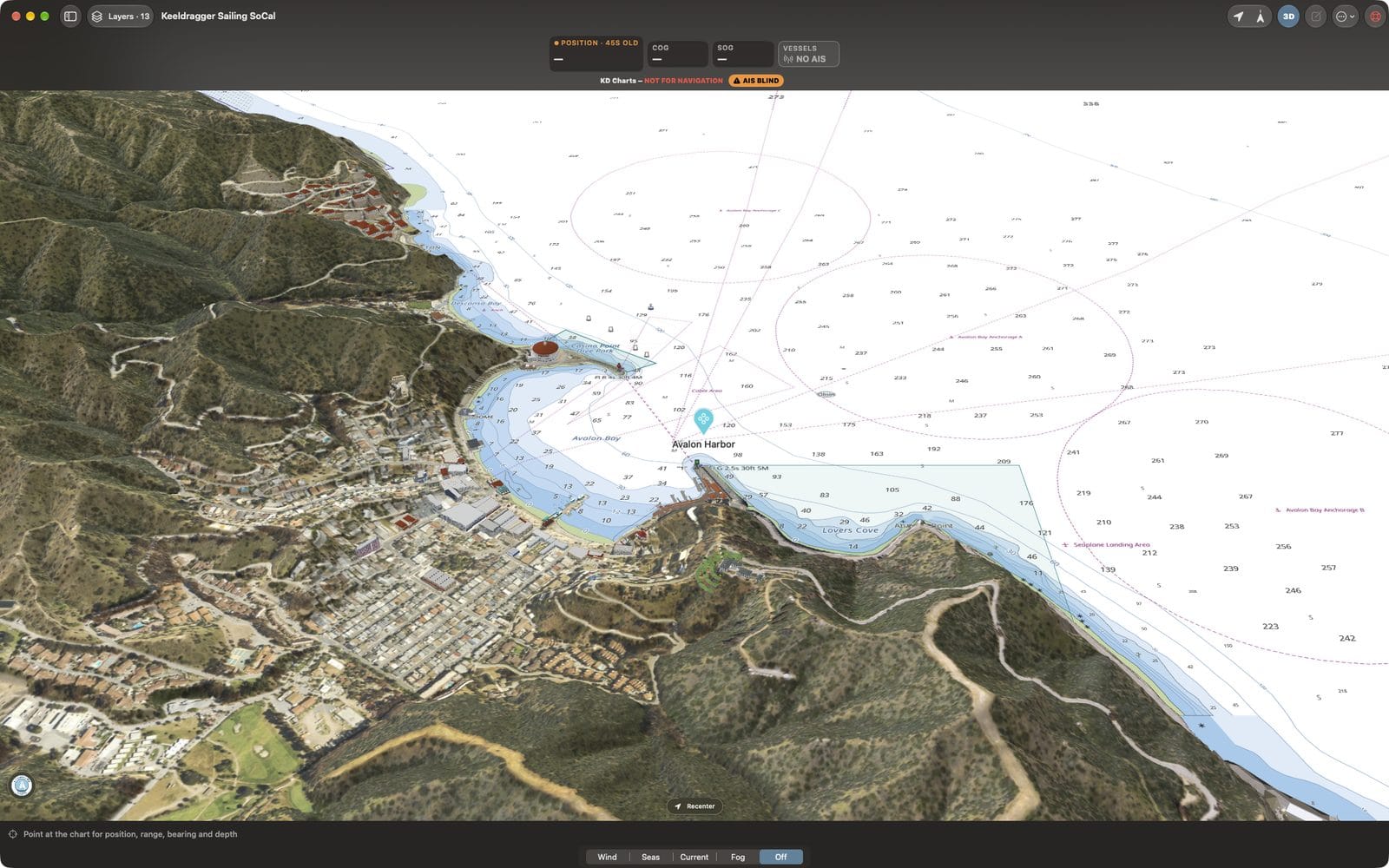
It's become my favorite way to "pre-sail" an anchorage before I get there. You can see how a cove is shaped, where the cliffs will shelter you and where the swell is going to wrap in.
Written by Sailors Who've Been There
Every waypoint in the guide is manually curated and written by sailors who have actually sailed there. No scraped reviews, no guesswork. Each page covers approach, holding, depth, moorings, radio contacts and exposure, and credits the sailor who wrote it. A night-by-night comfort forecast reads the swell against each anchorage's openings, so you know before you go whether you're in for a peaceful night or a rolly one.
The Official Word, Right on the Chart
Alongside that first-hand knowledge, the app puts the official word exactly where you need it: on the chart.
- Coast Pilot. NOAA Coast Pilot 7 notes on dozens of waypoints, plus entrance cautions.
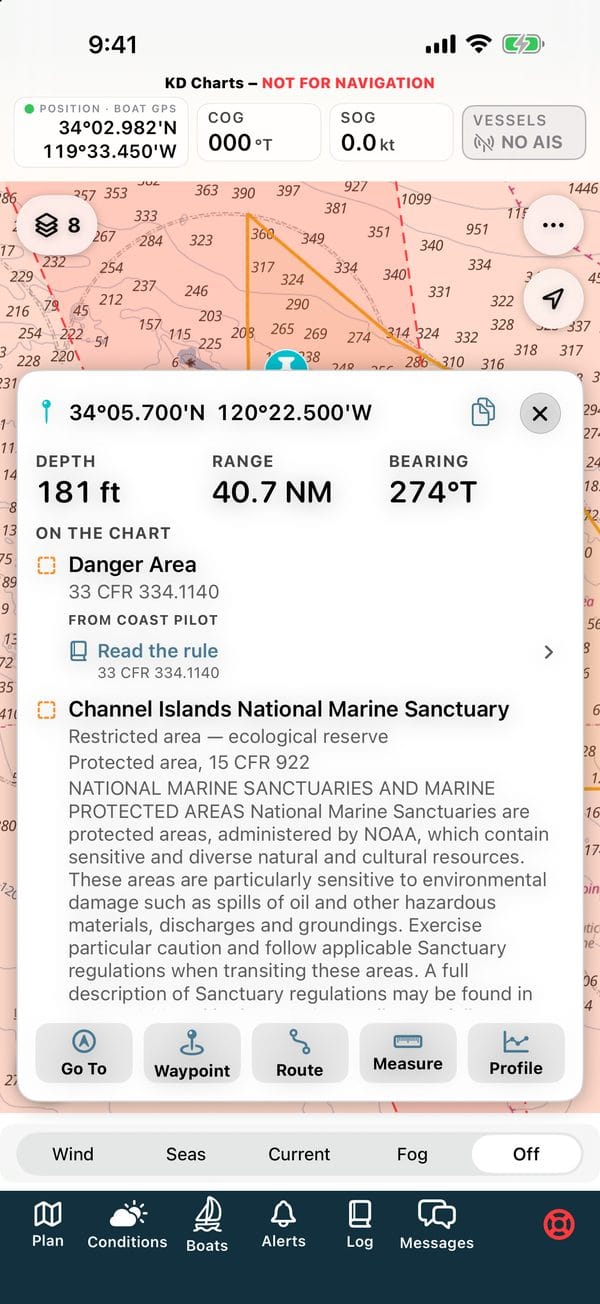
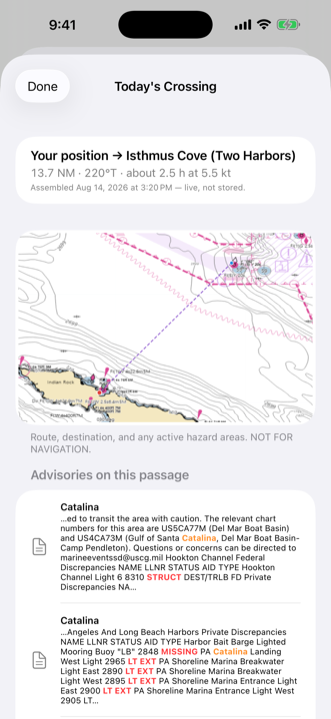
- Notices to Mariners. Coast Guard District 11's weekly Local Notices and live Broadcast Notices, filtered to your route, with active hazard zones drawn on the chart.
- Zones and rules. Military and security zones, marine protected areas and other regulated areas, each with a "read the rule" link so you know what actually applies to you.
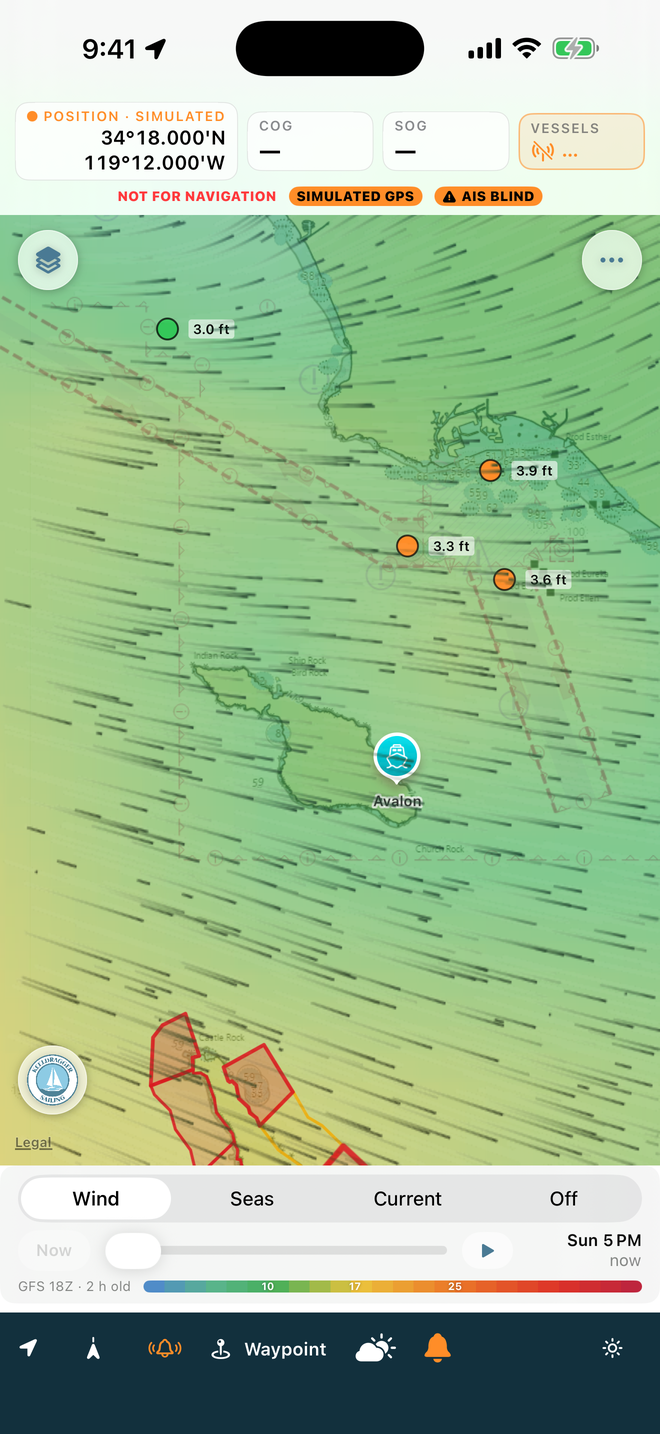
- Whales. Whale sightings and the Whale Presence Rating from UCSB's Whale Safe program.
A Few More Features I'm Proud Of
- Today's Crossing. A one-page passage briefing with a chart snapshot, the advisories along your track, the forecast and a shipping-lane warning. Print it, hand it to the crew, done.
- Forecast against your limits. Set your wind and sea limits and the departure matrix highlights any window that exceeds them. There's also an animated wind, sea and current field you can scrub three days ahead.
- Route check. Pick a destination and the app flags gale warnings, live-fire and rocket-launch zones, islands on your straight-line track, and whether you'll arrive after dark at your cruise speed.
- Avalon moorings, live. Current availability with your boat's size column highlighted, and the harbor maps cached for offline use.
- Underway and at anchor. An anchor alarm, AIS collision watch, MOB button, ship's log, buddy-boat check-ins and an Apple Watch companion.
It's Free. Come Aboard!
Keeldragger Sailing SoCal is free for iPhone, iPad, Mac and Apple Watch, and there's a free web edition too. No ads, no tracking and no account required. I built it as a gift to the sailing community that's given me so much, and that's how it's going to stay.
What I'd love most is your feedback. Tell me what's missing, what's wrong, and which anchorage notes need a local's correction. The guide gets better every time a sailor speaks up. Drop me a line at captain@keeldragger.com.
Get it on the App Store | Learn more at socal.keeldragger.com
See you out there. Maybe on a mooring in Avalon. 🍹
Fair winds,
Captain Mark Bunch
S/V Keeldragger · keeldragger.com
Keeldragger Sailing SoCal is a reference and planning tool and is not certified for navigation. Always carry official charts and use good seamanship.
Recipe Section
⚓💍 KC SPRING ROLLS: Read it, this one is good🌴⚓
: A Taste of Thailand, with a Whole Lot of Love! 🥢🥭
Some recipes feed the crew. Others come with a story that lasts a lifetime! ❤️
Back in 2024, during our Thailand flotilla, my daughter Kirstyn Cox, affectionately known as “The Kid”, made something very similar to these fresh, tropical spring rolls. 🌶️🍋🟩
But that night became memorable for rather more than the food. 💍
The Kid got engaged to Chad! ❤️
Fast-forward, and she’s now Kirstyn Ostler, happily married to Chad. And the wedding officiant? None other than Sailor Jerry! 🏴☠️🍹
But here’s the really special part. Almost everyone from that Thailand flotilla came along to celebrate their wedding! ⛵❤️
Think about that for a moment. A group of people brought together by a sailing adventure in Thailand, sharing incredible memories on the water, then coming together again to celebrate two people beginning their life together.
That’s the magic of a flotilla. You set out with a bunch of sailors, and sometimes you come home with lifelong friends who become part of your family’s story. 🌊🥂
So, in honour of Kirstyn, Chad, that unforgettable Thailand adventure and the wonderful crew who shared it all, we’re officially naming this recipe:
🌺🥢 KC SPRING ROLLS! 🥢🌺
Fresh fish, crunchy vegetables, tropical mango, fragrant herbs and a zingy tamarind dipping sauce. A little taste of Thailand, served with a generous helping of family memories.
Because at Gnomad, food is never just food. It’s the people, the places, the adventures and the stories that stay with us long after we’ve sailed away. ❤️
Here’s to Kirstyn and Chad, the Thailand flotilla crew, Sailor Jerry, and friendships that last well beyond the voyage! 🥂⚓
And Kid, you’ve officially earned your place in the Gnomad galley cookbook. Your spring rolls now have a story almost as good as the sauce! 😂❤️
🌴⚓ Gnomad KC Spring Rolls
Fresh Fish, Mango & Herbs with Sweet-Sour Tamarind Dipping Sauce
Eight hungry sailors, one galley, and a taste of the tropics! 🏴☠️ Perfect for a light lunch at anchor, a warm-weather dinner, or a colourful cockpit feast.
🍽️ Serves 8 sailors
⏱️ Prep 25 min · Cook 15 min
Yield: 24 spring rolls, approximately 3 per sailor
🛒 Ingredients
🥕 For the spring rolls
- 7 oz rice vermicelli noodles
- 35 oz (2 lb 3 oz) firm white fish, prawns or firm tofu
- 4 medium carrots, cut into thin strips
- 2 cucumbers, cut into thin strips
- 2 ripe but firm mangoes, cut into thin strips 🥭
- 4 cups bean sprouts
- 2 generous bunches fresh coriander (cilantro)
- 1 large bunch fresh mint
- 24 rice paper wrappers
- 4 tbsp coconut or peanut oil
- 8 garlic cloves, finely chopped
- 4 tsp fresh grated ginger
- 2 fresh red chillies, finely chopped, or dried chilli flakes to taste
- 4 tbsp fish sauce, or soy sauce for a vegetarian version
- 8 tsp lime juice, plus extra lime wedges
- Black pepper, to taste
🌶️ For the Gnomad tamarind dipping sauce
- 8½ oz tamarind pulp, or prepared tamarind paste adjusted to taste
- 4 cups water
- 8 garlic cloves, finely chopped
- 4 tbsp sugar or honey
- 4 tbsp fish sauce, or soy sauce
- 2 fresh red chillies, finely chopped, or dried chilli flakes to taste
- 4 tsp lime juice, added at the end
- Optional: 4 tsp sweet chilli sauce for extra tropical sweetness
Note: Tamarind paste varies in strength. If using concentrated paste instead of whole tamarind pulp, start with less and adjust to taste.
👨🍳 Instructions
1. Prepare the cargo
Cook the vermicelli noodles according to the packet instructions. Drain, rinse under cold water and drain thoroughly.
Cut the carrots, cucumbers and mangoes into thin strips. Wash the bean sprouts and pick the coriander and mint leaves.
2. Fire up the galley
Heat the coconut or peanut oil in a frying pan over medium heat. Working in batches, gently fry the garlic, ginger and chilli for about 30 seconds.
Add the fish or tofu, sliced into thin strips. Cook until the fish is fully cooked through or the tofu is lightly golden.
Stir in the fish sauce, lime juice and black pepper. Set aside.
3. Make the tamarind treasure
Combine the tamarind, water, garlic, sugar, fish sauce and chilli in a saucepan.
Bring to a gentle simmer and cook for about 5 minutes. Strain if using seeded tamarind pulp, then stir in the lime juice. Allow to cool.
Taste and adjust the balance. Add more sugar for sweetness, lime for zing, or chilli for a little extra fire from the galley! 🔥
4. Assemble the fleet
Arrange the noodles, fish or tofu, vegetables, mango and herbs in separate bowls.
Half-fill a wide frying pan or shallow dish with cool water. Dip one rice paper wrapper into the water until pliable, following the packet instructions.
Place a little of each filling near the bottom of the wrapper. Fold the bottom over the filling, fold in both sides, and roll firmly but gently.
Repeat until all 24 rolls are assembled.
5. Call the crew!
Arrange the spring rolls on large platters with lime wedges and bowls of tamarind dipping sauce.
Serve immediately for the freshest wrappers and crunchiest vegetables.
⛵ The Gnomad galley survival guide
- Small galley? Prepare the vegetables, noodles and dipping sauce ahead. Cook the fish just before serving.
- Provisioning for passage? Keep rice noodles, rice paper wrappers, tamarind paste and dried chilli in your dry stores. Frozen fish is a useful backup when it can be safely thawed.
- Feeding a ravenous crew? Three rolls per sailor is a light meal. For a more substantial dinner, increase to 32 rolls and add a noodle salad.
- Vegetarian crew member? Use firm tofu and soy sauce instead of fish and fish sauce.
- Tropical safety tip: Keep fish, prepared fillings and finished rolls refrigerated when not being served. Don’t leave them sitting in the sun.
🏴☠️ Captain’s serving suggestion: Scatter fresh mint over the platter, arrange lime wedges around the edges, and put the tamarind sauce front and centre.
Serve with a chilled lime-and-mint soda, gather the crew, and let the tropical feast begin! 🌴⚓
Some Useful Freebies
These are the tools I actually use out here, and if you sign up using my links below you’ll usually get a little bonus or discount, while also supporting Gnomad Sailing at no extra cost
- Morning: LMNT Hydration 🍊
- Route planning/Navigation: Savvy Navvy + Orca 🌬️
- Teaching: NauticEd modules 📚
- Crew online: Saily + Surfshark 🌍
- Journaling the madness: reMarkable ✍️
- Training, books, and newsletter: The Boat Galley
- Starlink
⚓ Some Youtube channels I follow and highly recommend: